The Problem
Aquaponics combines fish farming and plant cultivation in one water cycle: the fish produce nutrients, bacteria convert them, and the plants clean the water that flows back to the fish. In my greenhouse two separate systems – a left and a right side – are running, each with its own fish tank, grow bed and vertical pipe towers for lettuce. The fish are catfish.
Such a system only works if a handful of things run reliably, day and night, all year round:
- the water pump has to keep the water circulating,
- the air pump has to keep enough oxygen in the water,
- the water temperature has to stay in a narrow range – in winter the greenhouse gets cold, in summer it gets hot,
- and the fish have to be fed regularly and in the right amount.
Commercial controllers are either expensive, cloud-bound or impossible to integrate into an existing home automation. I wanted a solution that runs locally, uses cheap standard components, alerts me when something goes wrong and integrates into my Home Assistant installation – and ideally heats the water with solar surplus instead of grid power.
The Solution
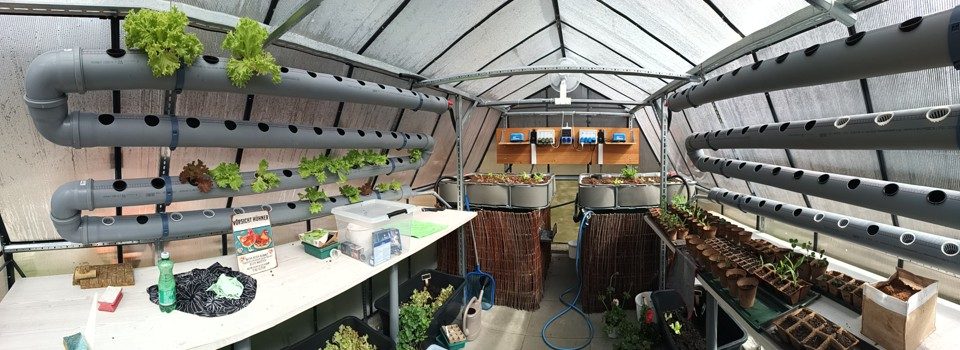
The picture shows the greenhouse shortly after the setup – the pipe towers are still waiting for their plants. It holds two identical systems. On the back wall a board carries the air pumps, the power distribution, an energy meter and the two controller boxes. Above each fish tank sits a 3D-printed automatic fish feeder; the lettuce grows in the gravel beds on top of the tanks and in the vertical pipe towers on both sides.
The controller: Fish-o-mat
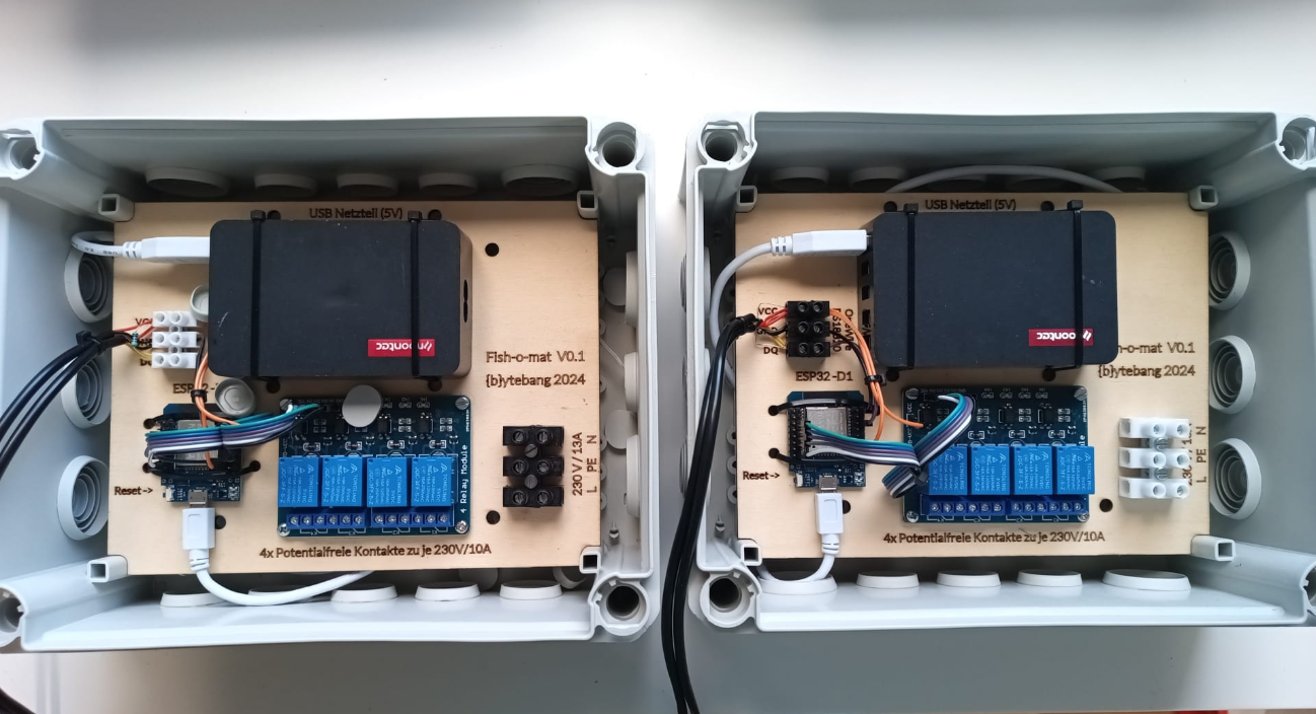
Each side has its own Fish-o-mat – a controller box built around an ESP32 running ESPHome. Each box contains:
- an ESP32-D1 mini connected via WiFi
- a 4-channel relay module with four potential-free contacts (230 V / 10 A each) for heating, cooling, air pump and water pump
- a 1-Wire bus (VCC, DQ, GND) for the temperature sensors – air temperature and substrate/water temperature
- a 5 V USB power supply for the electronics and terminals for the 230 V supply
All mechanical parts are designed by myself and produced with the tools of smart production: the mounting plate is laser-cut from plywood with all connections engraved directly on it (“USB Netzteil (5V)”, “4x Potentialfreie Kontakte zu je 230V/10A”, the reset button …), so maintenance is easy even years later. The fish feeders are 3D printed (model on MakerWorld, firmware on GitHub). Everything sits in standard IP-rated junction boxes.
Caution: These boxes switch mains voltage. Work on 230 V installations must only be carried out by qualified persons.
Firmware
The firmware is a plain ESPHome configuration: the temperature sensors and the four relays are declared in a few lines of YAML, and ESPHome makes them available to Home Assistant via its native API – no MQTT broker or custom code required. The control logic itself (thermostat, timers, PV surplus) lives in Home Assistant.
Home Assistant
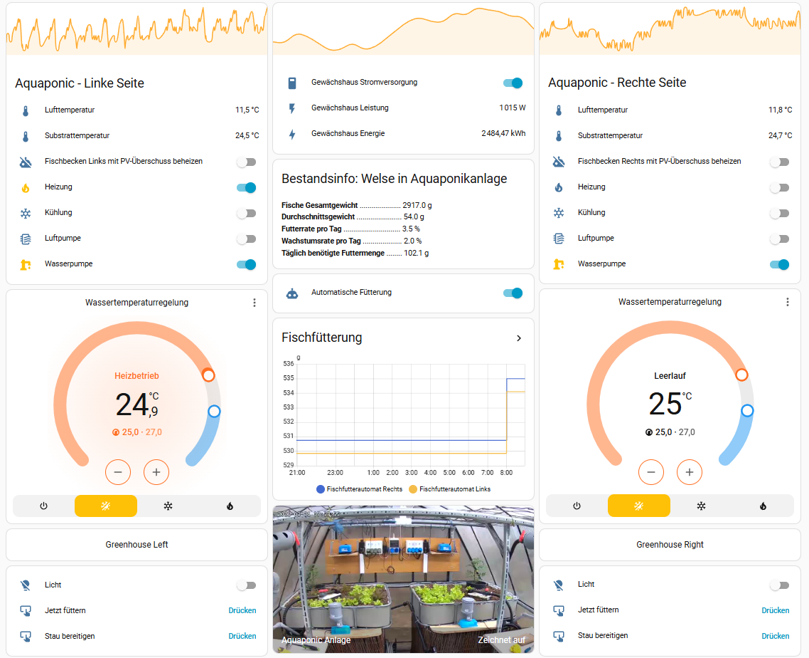
The dashboard mirrors the physical layout: the left system on the left, the right system on the right, shared information in the middle.
- Per side: air and substrate temperature, the state of heating, cooling, air pump and water pump, and a thermostat that keeps the water between 25 and 27 °C. Light, feed now and clear jam are available as buttons.
- PV surplus heating: a switch per tank lets the heating run on solar surplus, so the water is warmed with energy that would otherwise be fed into the grid.
- Energy: the greenhouse power supply can be switched centrally; current power and total energy consumption are measured.
- Stock information: from the total fish weight Home Assistant calculates the average weight, the daily growth and the required amount of food per day (feeding rate 3.5 % of the body weight).
- Feeding: the automatic feeding can be switched on and off; a chart shows the weight of both food reservoirs, so you can see at a glance whether each feeding actually happened.
- Camera: a live view of the greenhouse.
The result
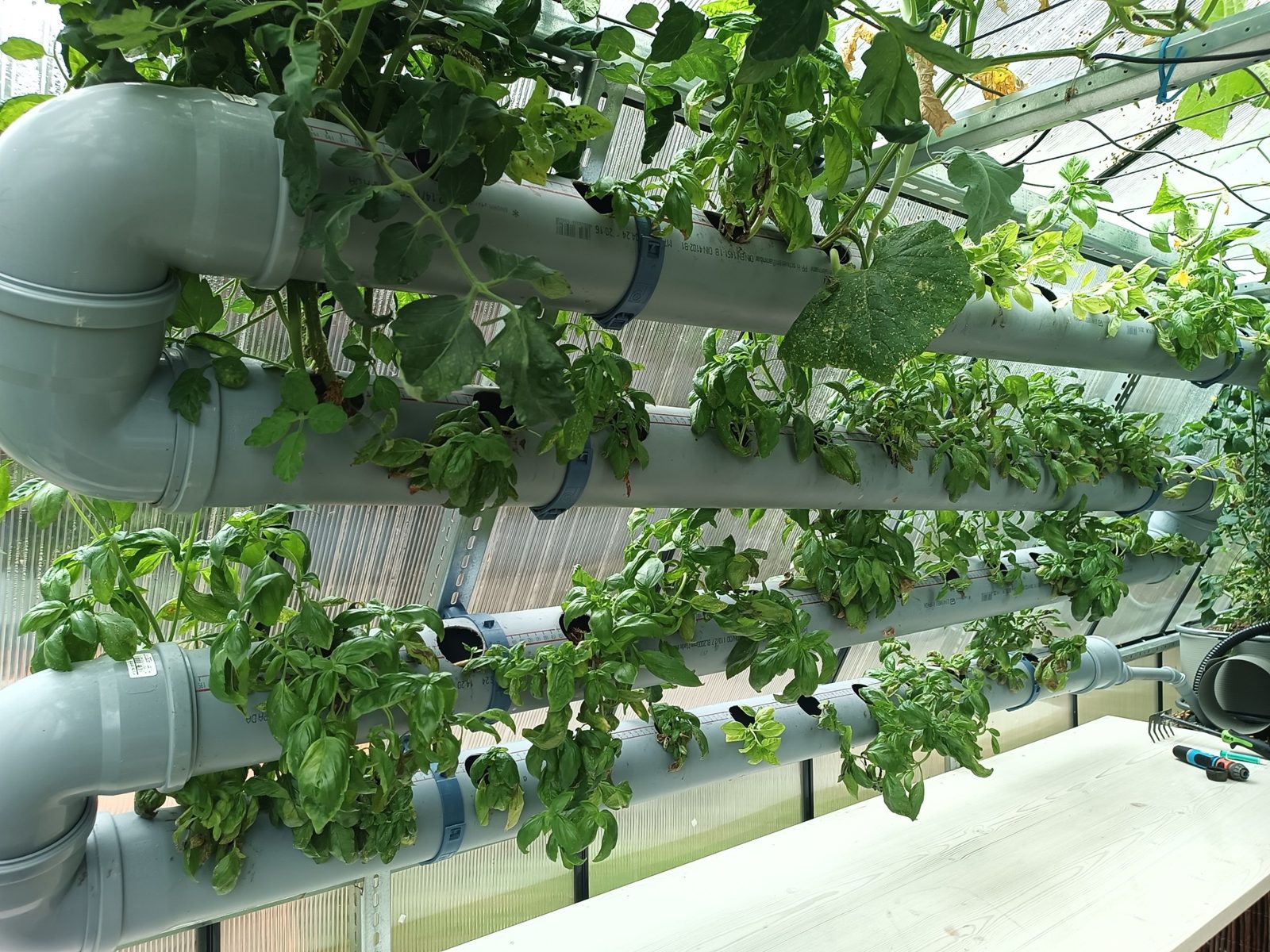
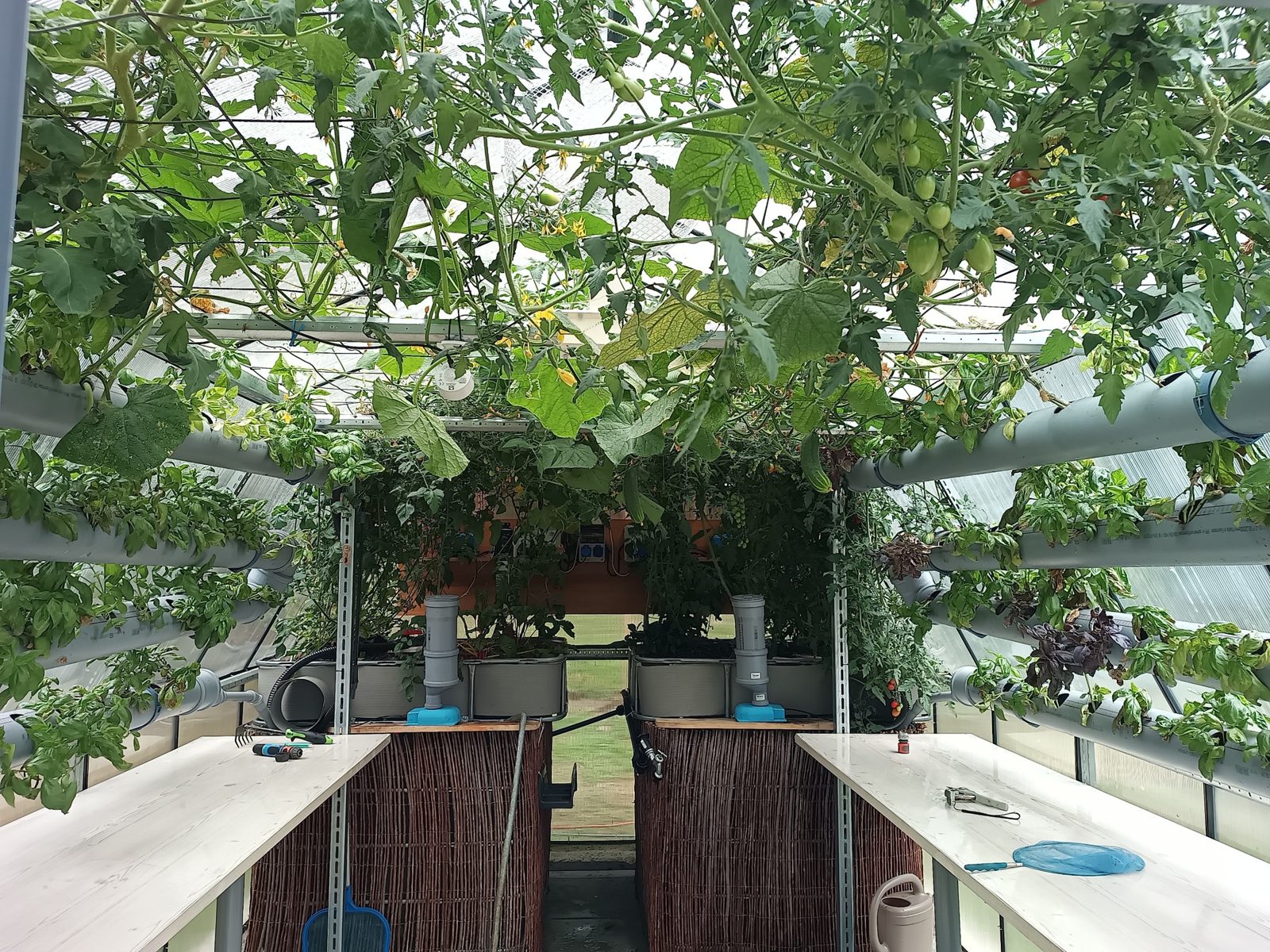
The fish supply the fertilizer, the system does the rest: in summer basil fills the pipe towers, and tomatoes and cucumbers grow up to the roof of the greenhouse.
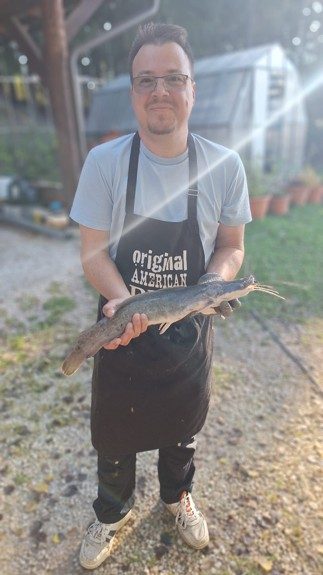
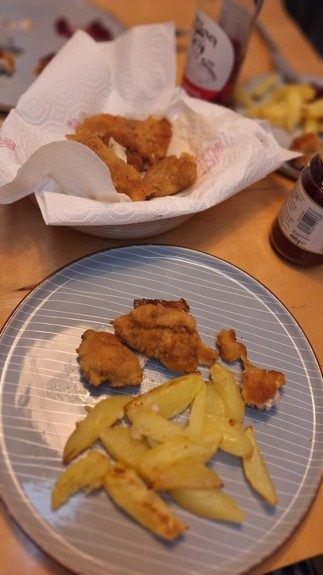
And of course the fish are part of the harvest as well:
Conclusion
After one full season (March to November) these are my take-aways:
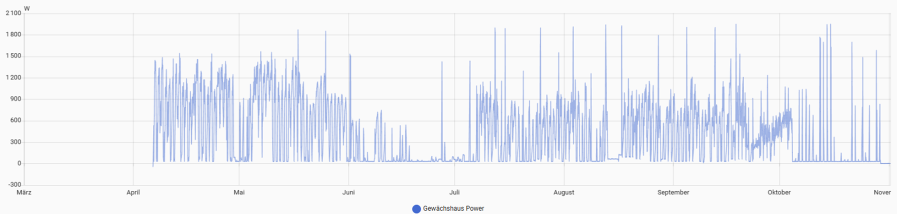
- Heating is a must in spring and autumn. From March to April and again from September the water has to be heated. That added up to about 2 MWh of electricity – all of it solar power from my own PV system, which is exactly why the PV surplus switch exists.
- Cooling is a must in summer. On sunny days the greenhouse reaches peaks of more than 50 °C.
- Zero tolerance for errors. Plants and fish are living beings: a pump that stops or a heater that gets stuck can wipe out a whole season. Reliable hardware and alerts are not optional.
- About one hour of work per week, averaged over the season: measuring water parameters, cleaning filters, harvesting and cleaning up.
- Growth is exponential – and so is the cleaning effort. The upside: the fertilizer gain grows as well, and the garden is grateful.
The numbers of one season
| Fish food | about 65 kg (99 % commercial food with 48 % protein and 13 % fat; the rest brewer’s grains, worms …) |
| Yield fish | about 55 kg of catfish (≈ 25 kg fillet) |
| Yield vegetables | 0.5–3 kg per week, about 50–70 kg per season |
| Costs fish (fingerlings) | about € 75 |
| Costs food | about € 120 |
| Costs electricity | € 0 thanks to the own PV system (otherwise about € 600) |
| Care | about 40 h per season, plus one weekend for planting and winterizing and one weekend for harvesting and preserving the fish |
Building the system was a one-time effort of about 200 hours for the greenhouse including the foundation and about 100 hours for planning and developing the concept – including roughly 40 hours for building and testing the fish feeder, 20 hours for the ebb-and-flow siphon and 10 hours for the solids filter.
Doing it yourself is the key to cost efficiency – and building it is half the fun.